
Cabarrus County Traffic Court Schedule
Cabarrus traffic cases are handled in North Carolina District Court, with a local Administrative Traffic Court page published by the Judicial Branch. Cabarrus Administrative Traffic Court is held every first and third Friday. Each person with a citation has an opportunity to speak with an Assistant District Attorney before the case is called before the judge. The ADA cannot give legal advice, but the official page says some cases may be negotiated and reduced.
This local process matters because a traffic citation can have more than one access path. A person may need to search the court date, check whether the citation is payable, appear in court, or ask about a reduction. If the ticket requires court or if the person wants to contest it, payment alone is not the same as appearing on a docketed traffic setting.
The Cabarrus Administrative Traffic Court page is the source for the traffic court image below.
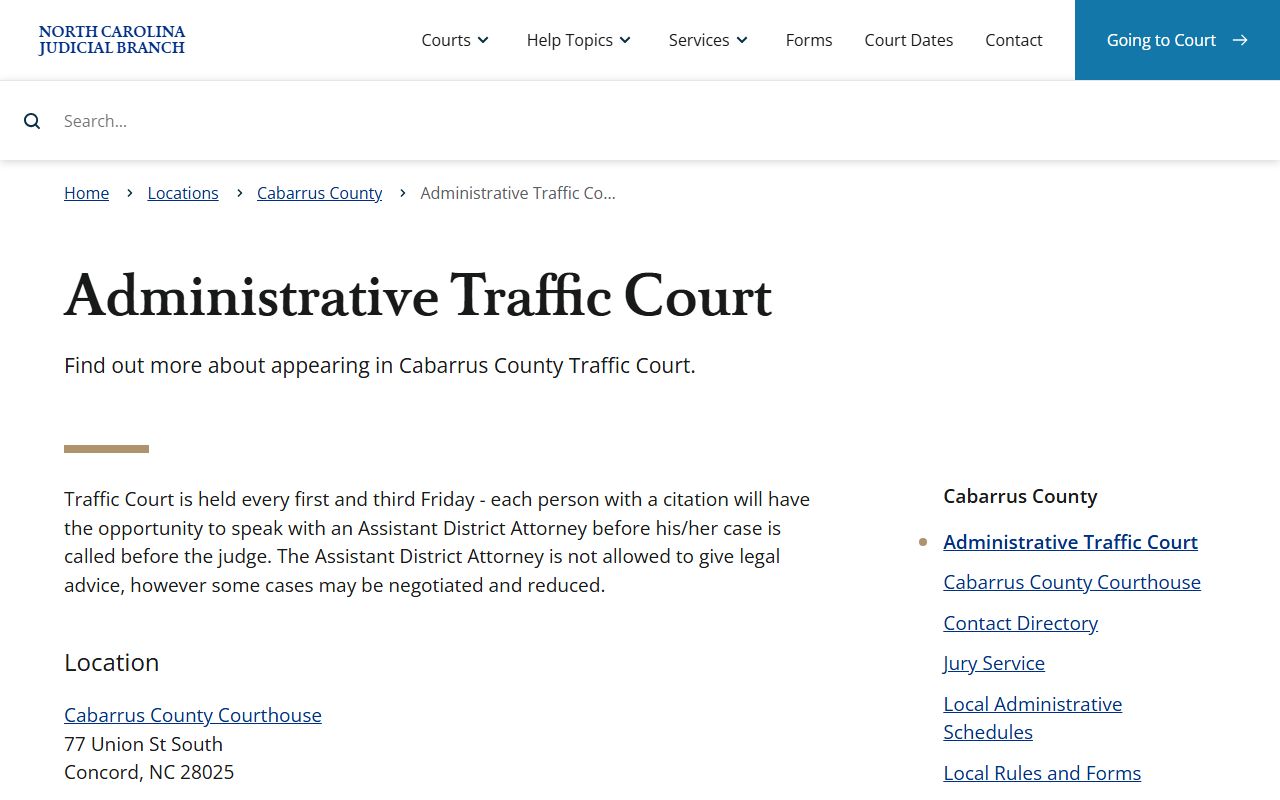
That official page supplies the first and third Friday schedule and the local ADA discussion detail for Cabarrus traffic cases.
Search Cabarrus County Traffic Court Records
Traffic case lookup can use the North Carolina eCourts Portal and court-date search tools linked from Cabarrus Judicial Branch pages. The research identifies eCourts as the source for case information by citation, name, case number, and hearing search fields. The local administrative schedules page also links court-date search by name, citation number, county, and more.
Search by citation number when the ticket is in hand. It is the most direct way to match a traffic citation to the court case and payment path. Search by name when the citation number is unknown, but narrow the search to Cabarrus County and check case details carefully. Search Hearings can also use attorney, bar number, judicial officer, or courtroom fields when the issue is a court setting rather than a general case summary.
| Field Label | Type | Required | Notes / Format |
|---|---|---|---|
| Citation number | Text | Optional but best for tickets | Court-date search supports citation number, and mail payment must include the citation number. |
| Name | Text | Optional | Use for court-date search when the citation number is not known. |
| County | Dropdown/filter | Optional | Choose Cabarrus to narrow the traffic court record search. |
| Case number | Text | Optional | Used in Portal case search and payment lookup. |
| Attorney or bar number | Text | Optional | Hearing search supports attorney fields. |
| Judicial officer or courtroom | Text/dropdown | Optional | Hearing search supports these fields for calendar lookup. |
Pay or Contest Cabarrus Traffic Tickets
Cabarrus payment rules depend on whether the citation is eligible to be paid without a court appearance. The Judicial Branch payment page says eligible fines and fees may be paid online through Portal or online services. If the citation is eligible for mail payment, the requester must include the citation number and use money order or certified check. Cash, personal checks, and credit cards are not accepted by mail. The payment must be made payable to Cabarrus County Clerk of Superior Court and mailed to Cabarrus County Courthouse, PO Box 70, Concord, NC 28026-0070, ATTN: Bookkeeping.
In-person payment is made at the Clerk of Superior Court in Room 104, identified by the red sign over the door. Accepted in-person methods are cash, credit or debit card with processing fees and restrictions, money order, and certified check. The payment page lists MasterCard, Visa, American Express, and Discover for credit/debit payment, and says personal checks are not accepted. A cash machine is in the courthouse.
- Read the citation and determine whether it is waivable or requires a court appearance.
- Search the court date by citation number, name, county, or Portal case search.
- If eligible and choosing to waive or pay, use online payment if available, mail certified funds with the citation number, or pay in person at Room 104.
- If contesting the ticket or seeking a reduction, appear in Administrative Traffic Court on the scheduled date or follow official rescheduling instructions.
- On first or third Friday Administrative Traffic Court, speak with the Assistant District Attorney if appropriate before the case is called.
- After disposition, check NCDMV separately if license status, points, suspensions, or insurance consequences matter.
The Cabarrus County payment information page is the source for the payment image below.
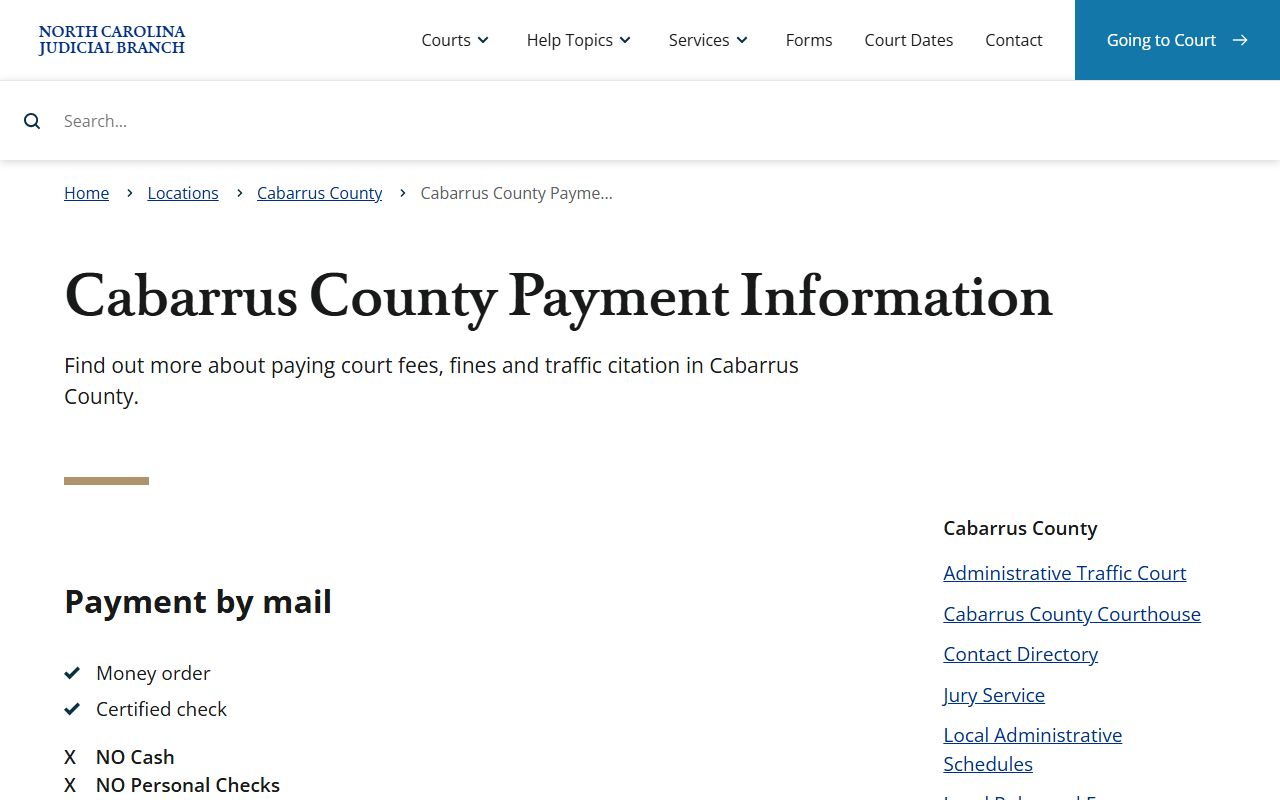
That page supplies the mail address, Room 104 in-person payment note, accepted in-person methods, and mail-payment restrictions.
Cabarrus Traffic Court Record Fields
A traffic court record is the court's case file or case summary for the citation. It can show the citation or case number, charge, court date, plea or disposition, hearing events, failure-to-appear or order activity, costs, fines, and financial entries. It may also show public documents when Portal access permits. The record does not replace the NCDMV driver record.
| Field | What It Shows |
|---|---|
| Citation number | The ticket identifier used for court-date lookup and required for mail payment. |
| Case number | The court case identifier used in Portal case search and payment. |
| Defendant or party name | The person tied to the traffic case. |
| Charge | The alleged traffic offense, infraction, or traffic misdemeanor filed in District Court. |
| Court date and hearing type | The scheduled traffic setting, hearing type, courtroom, or calendar entry where visible. |
| Disposition | The court outcome, such as disposed, dismissed, reduced, or another case result where public. |
| Failure-to-appear activity | Court action tied to missing a required setting, when present in the record. |
| Financial entries | Costs, fines, payment status, and other financial categories where applicable. |
| Documents | Public orders or related records when online document access permits. |
Note: A traffic court disposition can affect DMV records, but the court file and driver history are separate records.
Cabarrus Traffic Courts and Dockets
Cabarrus traffic citations are District Court records in North Carolina's unified court system. Municipal police departments may issue citations, and the Sheriff's Office may have law-enforcement records, but once a traffic citation becomes a court case it belongs to the state trial court structure. The Clerk of Superior Court is the local court-record custodian for court files and payment handling.
| Court or Office | Traffic Role | Cabarrus Access Point |
|---|---|---|
| District Court | Handles traffic citations, infractions, misdemeanors, and related high-volume traffic matters. | Cabarrus County Courthouse, 61 Union Street South, Concord, NC 28025. |
| Administrative Traffic Court | First and third Friday traffic court with ADA discussion opportunity before the judge calls the case. | Judicial Branch Cabarrus Administrative Traffic Court page and local schedules. |
| Clerk of Superior Court | Maintains court records, handles eligible payments, and provides copies or terminal access. | Room 104 for in-person payments, phone (704) 262-5500. |
| NCDMV | Maintains driver records, points, license status, and reported convictions. | MyDMV and NCDMV records services, separate from court case lookup. |
Court Traffic Records vs DMV Records
The most important traffic-record split is the difference between the Cabarrus court case and the statewide driver record. The court record explains the citation case. The NCDMV record explains the driver's license history and consequences that are reported to DMV. A crash report is a third category. It documents a crash event and does not prove the final court disposition of a citation.
| Record | Custodian | What It Shows | What It Does Not Replace |
|---|---|---|---|
| Court traffic record | NC Judicial Branch and Cabarrus Clerk | Citation/case number, charge, court date, plea or disposition, costs/fines, failure-to-appear or order activity, and hearing events. | Does not show full driver license history or all DMV points and status. |
| NCDMV driving record | N.C. Division of Motor Vehicles | Driver license history, convictions reported to DMV, license status, points, suspensions, and driver record data. | Does not provide full court pleadings, motions, or judge orders in the traffic case file. |
| Crash report | NCDMV or law-enforcement crash system | Crash report details, with NCDMV requiring requester ID details, driver license number of the driver involved, and crash date. | Does not equal a traffic citation case and does not prove court disposition. |
The NCDMV driving-record request page is the source for the driving-record image below.
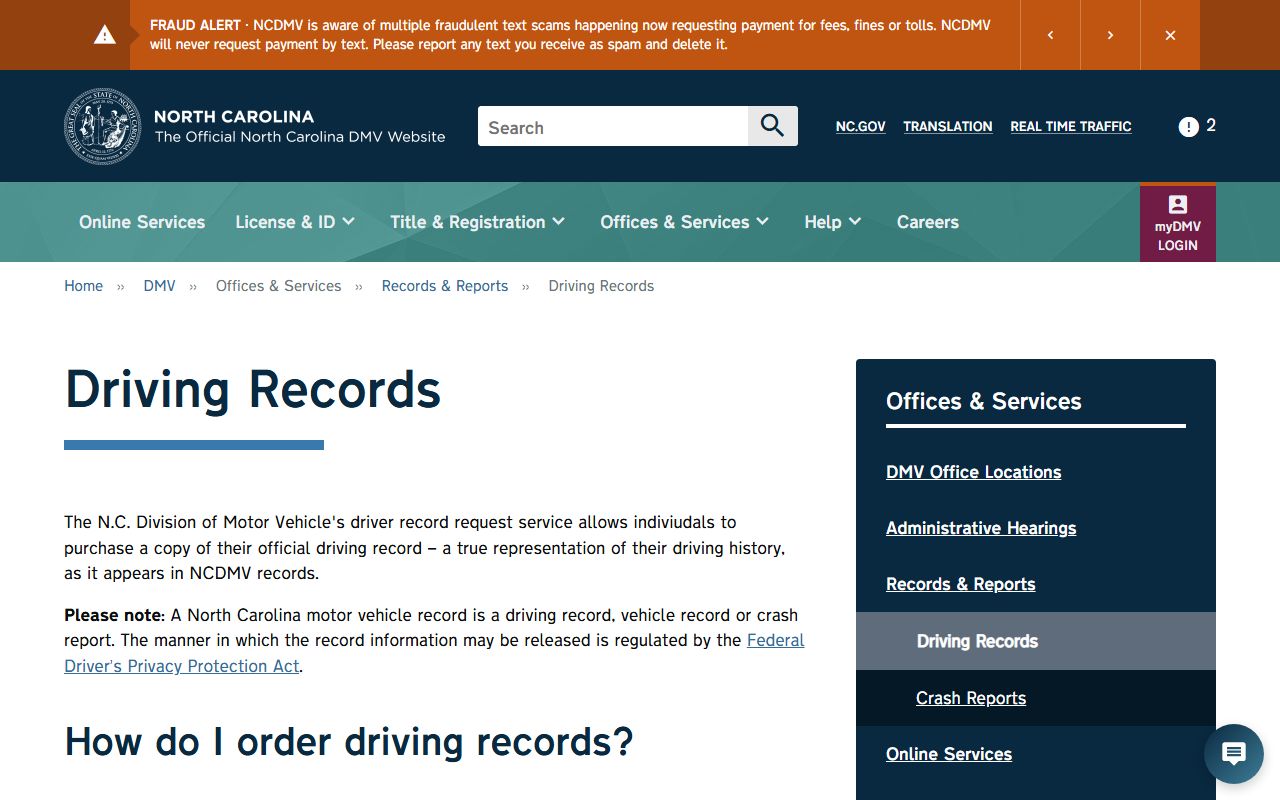
That NCDMV source belongs to driver-history access, not the court case file maintained through the Cabarrus Clerk and eCourts.
NCDMV Driver Record Search Fields
NCDMV online driving-record access uses different identity and legal-use fields than the traffic court record search. The MyDMV path requires a valid North Carolina driver license or ID issued after January 2000, the last four digits of Social Security number or I-94 or alien registration number, and date of birth. The driving-record terms also require an intended-use certification under DPPA and North Carolina law.
| Field Label | Type | Required | Notes / Format |
|---|---|---|---|
| Valid NC driver license or ID | Credential | Required for MyDMV online request | Must be issued after January 2000 for MyDMV login. |
| Social Security last four, I-94, or alien registration number | Text | Required | Identity field for MyDMV login. |
| Date of birth | Date | Required | Identity field for MyDMV login. |
| DPPA intended-use certification | Certification/checkbox | Required | Driving-record terms require a legitimate need under DPPA and N.C. G.S. 20-43.1. |
| Requester NC driver license or ID | Credential | Required online for third-party requester | Used when the requester is not the license holder. |
The NCDMV MyDMV portal is the source for the MyDMV image below.
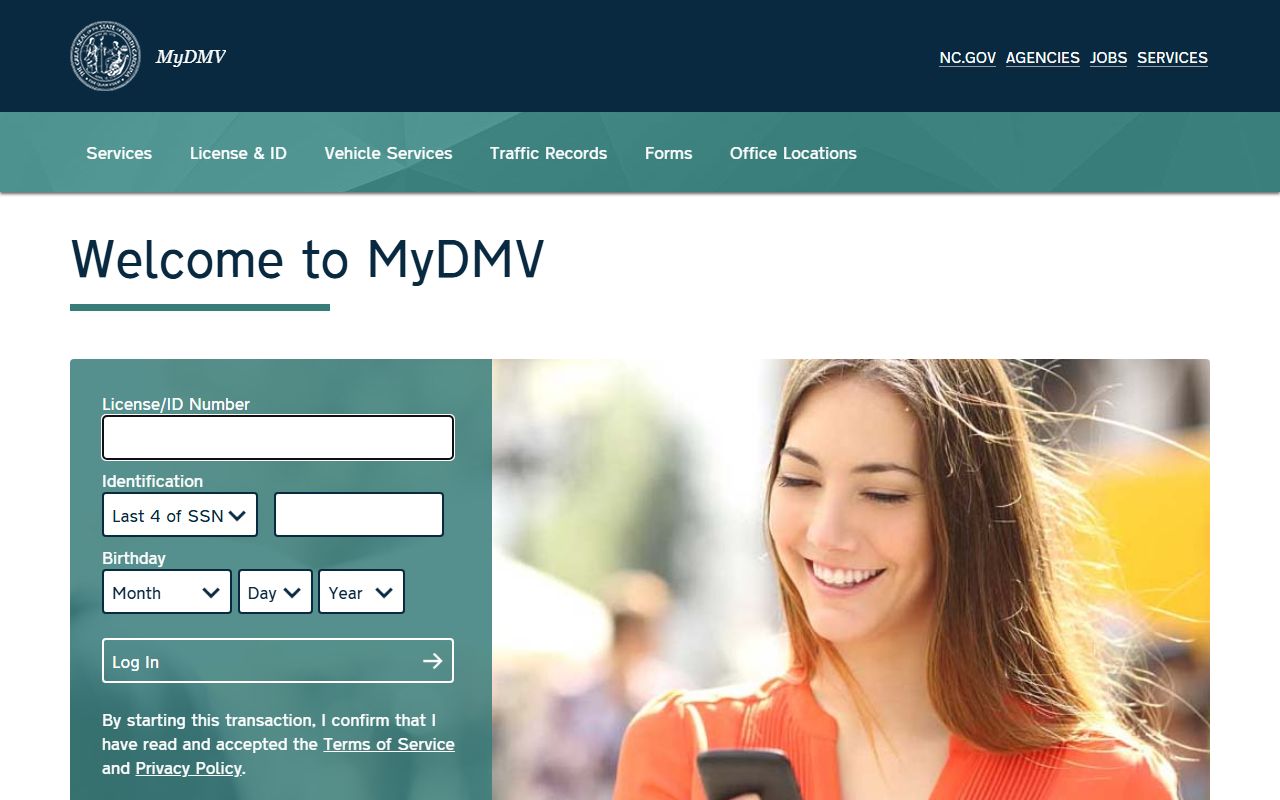
MyDMV is useful after court disposition when license status, points, or suspension history must be checked separately from the Cabarrus traffic case.
Crash, CDL, and DWI Records
Crash reports are not traffic court records. The NCDMV crash-report page requires requestor ID details, the driver license number of the driver involved, and the crash date. A crash report may help explain an accident event, but it does not prove whether a traffic citation was filed, reduced, dismissed, paid, or disposed in court. Search the court case separately for the citation outcome.
Commercial driver issues should also be checked in both places. The Cabarrus court record shows the citation case and disposition. The NCDMV driver record shows license status, points, suspensions, and convictions reported to DMV. The assigned research did not locate a Cabarrus-specific CDL diversion or defensive-driving program, so CDL holders should not assume a local reduction, waiver, or course option applies without court or DMV confirmation.
DWI and impaired-driving cases can start from a traffic stop, but they route into criminal court records when criminal charges are filed. The citation or hearing may appear in traffic-related searches, yet the full charge, plea, disposition, sentence, and probation terms belong in the criminal case file. For the broader criminal case path, use Cabarrus County criminal court records.
The NCDMV crash-report page is the source for the crash-report image below.
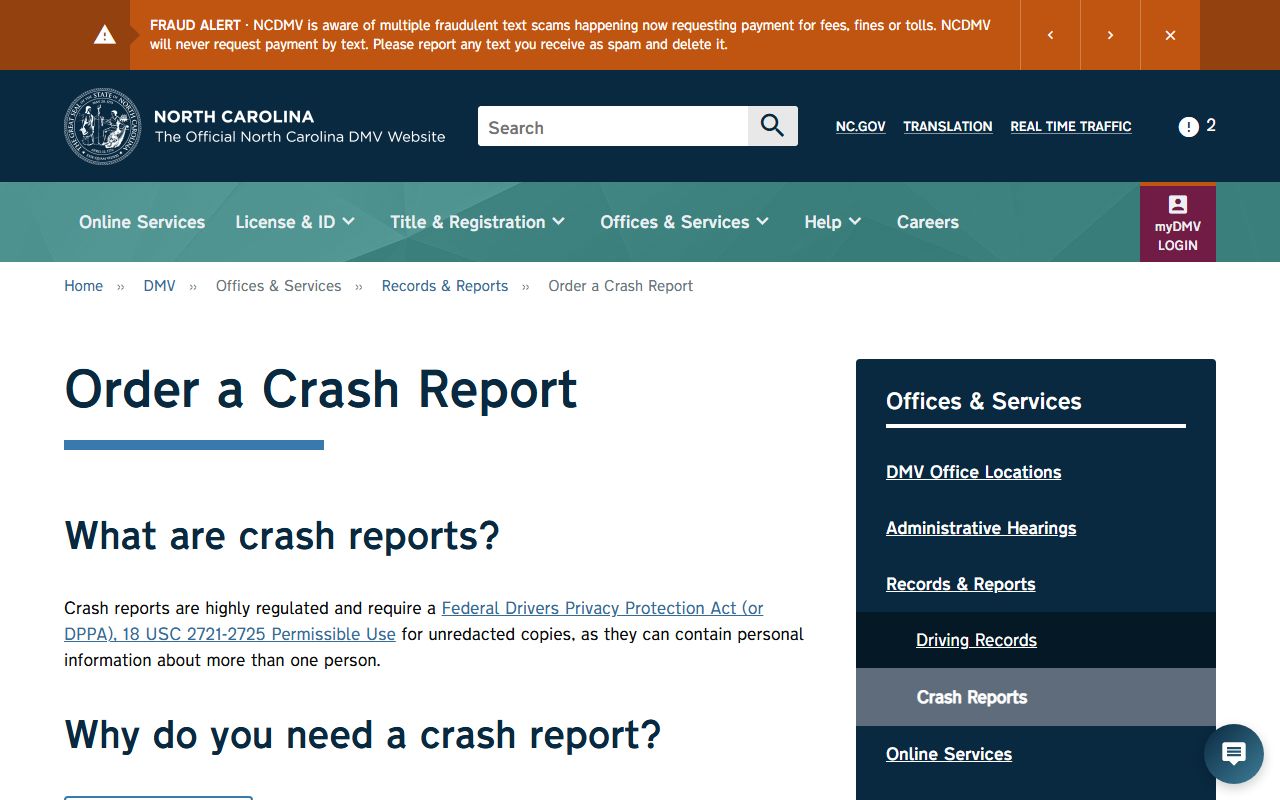
That crash-report source reinforces that crash documentation and traffic citation case records answer different questions.
Cabarrus Traffic Payment Rules
The official Cabarrus payment research gives payment methods and restrictions, not a full fine or copy-fee table for every traffic offense. Do not infer a fine from the charge title alone. Traffic costs can depend on the exact charge, waiver eligibility, court costs, disposition, failure-to-appear activity, and whether the person appears or pays. Portal, the Clerk, or the official citation should be used for the specific amount.
| Item | Official Rule Located |
|---|---|
| Online payment | Eligible fines and fees may be payable through Portal or official online services. |
| Mail payment | Include citation number. Use money order or certified check. No cash, personal checks, or credit cards by mail. |
| Payee for mail | Make payable to Cabarrus County Clerk of Superior Court. |
| Mail address | Cabarrus County Courthouse, PO Box 70, Concord, NC 28026-0070, ATTN: Bookkeeping. |
| In-person payment | Clerk of Superior Court, Room 104, red sign over door, Cabarrus County Courthouse. |
| In-person methods | Cash, credit/debit card with processing fees and restrictions, money order, and certified check. No personal checks. |
| Specific fines or copy fees | Not located as a Cabarrus traffic schedule in the assigned research. Confirm through Portal or the Clerk. |
The NCDMV driving-record terms page is the source for the DPPA terms image below.
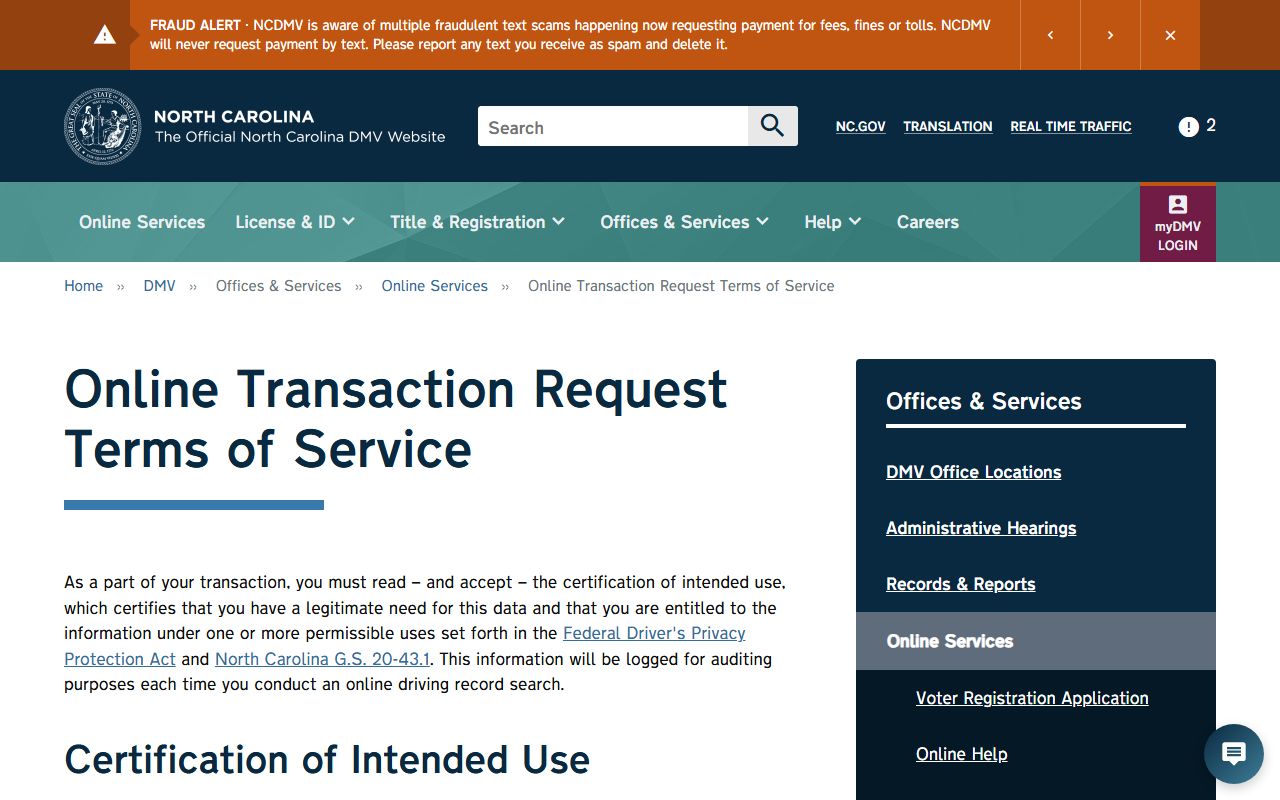
Those terms apply to DMV driver-record access and should not be confused with public court case lookup through the Judicial Branch.
Public Access to Traffic Court Records
Cabarrus traffic court records are court records held in the North Carolina trial court system. G.S. 132-1 defines public records broadly, and G.S. 7A-109 requires clerks to keep court records, files, dockets, and indexes open to public inspection unless the law prohibits access. Public Portal access is the first stop for many traffic cases, but Clerk access remains important when a record is older, incomplete, paper-based, or needed in copy form.
Traffic records can still have limits. Juvenile matters, sealed or expunged entries, protected personal information, and certain criminal or law-enforcement materials may be restricted. Dismissed or not-guilty matters may qualify for expunction under G.S. 15A-146. Certain nonviolent misdemeanor and felony convictions have separate expunction paths under G.S. 15A-145.5. The assigned research did not locate a Cabarrus-specific traffic expunction shortcut, so the state court process and Clerk filing path control.
Defensive driving, reduction, or deferred-resolution options should be confirmed through official court channels. The Cabarrus Administrative Traffic Court page supports ADA discussions before the case is called, but it also says the ADA cannot give legal advice. Eligibility can depend on the charge, driving history, court policy, and DMV consequences.